
If your inner voice is already whispering “you’re behind on Q4,” take a breath, because you’re not. The panic you’re feeling is the same panic every founder feels reading a “start early” headline while the weather still says summer. What almost nobody tells you is which month actually does what. This Pinterest Q4 calendar exists so you don’t have to keep guessing what “start early” is actually supposed to mean.
Reading this in September? You’re not behind either. Run August’s foundation checklist this week, it’s short, then pick up at September below.
Here’s what this post won’t do: re-argue that Pinterest campaigns need lead time. I made that case in full already, with the catalog-to-Performance+-to-editorial framework behind it. Go read that one if you want the “why.” This one is the “what, exactly, and when.”
One more thing most Q4 content skips entirely: Pinterest itself has a name for the week after Christmas. It calls it Q5. Almost nobody plans for it, which is exactly why it’s worth five minutes of your time in December.
The logic behind this Pinterest Q4 calendar
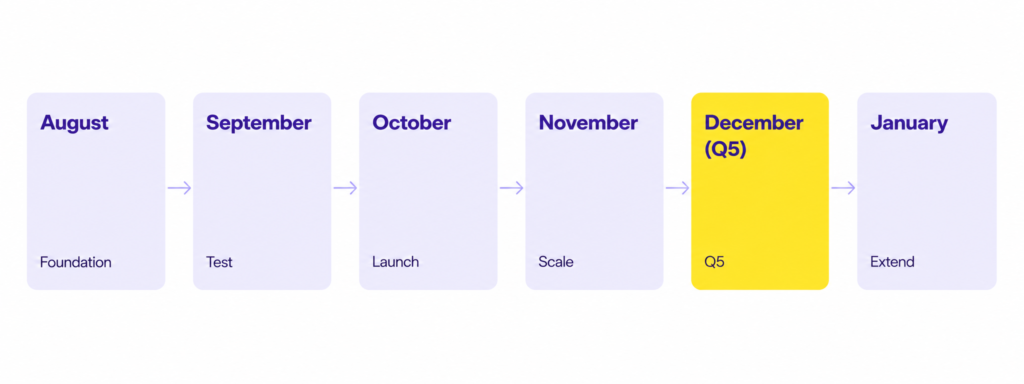
Pinterest’s own advice is simple: launch a campaign roughly two months before the moment it’s meant to catch peaks in search. If gifting searches peak in October, foundational work needs to be done by August. That’s not a slogan, it’s Pinterest’s stated rule from its 2026 Marketing Moments guide, and it’s the one principle every month below is built on.
Here’s the number that should make August feel less like a chore and more like a decision: Pinterest advertisers who run shopping campaigns for six months or longer see about 33% higher ROAS than those running under three months, according to Pinterest’s own 2026 holiday guidance. Starting the groundwork now isn’t about being anxious. It’s about compounding.
Below is the actual calendar, month by month, built on top of Pinterest’s own four-step framework (foundation, activate, test, scale). No vague “focus on holiday prep.” Just what to do, and roughly when.
August: foundation month (before you spend a cent)
In one sentence: August is for fixing what’s broken on your Shopify side before Pinterest sees a single ad dollar from you. It’s month one of this Pinterest Q4 calendar for a reason.
This is Pinterest’s own step one, explicitly listed before spending begins: catalog uploaded, tag installed, KPIs defined. Concretely, that means:
- Audit your product feed. Check stock accuracy, pricing sync, and dead or broken product URLs.
- Verify your Pinterest tag is actually firing (not just installed two years ago and forgotten).
- Write down your Q4 KPIs now, while you’re calm, so November-you isn’t inventing targets under pressure.
Here’s the part nobody puts in a checklist because it sounds boring until it happens to you: Pinterest’s shopping-ads guidance suggests it flags feed issues like price mismatches or false stock status and gives merchants a short window to fix them before pulling products from shopping surfaces, and if enough of your catalog is affected, the whole feed can get suspended pending review. Treat that as directional guidance rather than a precise rulebook, since the exact hours-and-percentage figures come from third-party summaries, not Pinterest’s raw policy page. Either way, the risk is real: a messy feed in November doesn’t just underperform, it can get pulled entirely, on the exact days you need it most.
If you want the full framework behind why catalog hygiene sits underneath everything else, my pillar post walks through it.
September: test, don’t guess
In one sentence: September is for running small, cheap experiments while nobody’s watching yet.
Use back-to-school as your rehearsal moment, not a real campaign target. What you’re actually testing: creative formats, audiences, and whether your always-on setup even works before real budget lands on it. Also worth doing now:
- Start building seasonal boards and pins ahead of the October gift-list surge, so they’re already indexed and gathering saves when shoppers start looking.
- Lock hero-SKU inventory. Cross-industry ecommerce advice (not Pinterest-specific) suggests best-sellers often need ordering eight-plus weeks ahead of peak, so this is the month to place that order, not November.
Here’s the quiet financial argument for doing this now rather than waiting: agency CPM data suggests Pinterest ad costs in September still sit closer to shoulder-season levels, before the November crunch. Cheap now, pricier later, that’s the whole argument. Nobody’s numbers here are Pinterest’s own, since Pinterest hasn’t published Q4 CPM figures, so treat the specific dollar ranges as directional. But the shape holds: cheaper impressions now build your retargeting pool cheaper, and that’s the pool you’ll lean on when costs rise.
If you’re unsure which pin formats to build for that surge, I broke down what actually works right now in my guide to Pinterest content formats.
``
October: go live, use Halloween as your dress rehearsal
In one sentence: October is when Pinterest’s own guidance says most brands should be fully live, and Halloween is where you prove your creative before real budget lands on it in November.
Pinterest’s official 2026 framework recommends launching your full holiday campaign as early as possible within a September-to-November window, then scaling from there. If August was foundation and September was testing, October is “stop testing, start running.” Concretely, that means:
- Take whatever won in your September tests, the format, the audience, the angle, and turn it into your actual live campaign. Don’t launch five new ideas in October. Scale the one that already worked.
- Use Halloween itself as the second rehearsal moment: run it as a small, contained test of your gifting messaging (or Halloween-specific messaging, if that’s genuinely your category) against a control, and judge it on saves and outbound clicks, not just impressions, since that’s what tells you what deserves November’s budget.
- Build and publish your November gift-guide boards and pins now, before the surge hits, so they’re already indexed by the time shoppers start searching in earnest, the same index-ahead logic you used in September.
- If CPMs really are still closer to shoulder-season levels in October, per agency estimates, this is close to your last window to buy volume before the November price climb. Don’t sit on budget waiting for “peak season” to feel real.
One stat worth knowing, with an honest asterisk on it: last year’s Pinterest holiday guide cited that roughly 31% of the platform’s audience starts building gift lists as early as October, a full six to eight weeks ahead of when the same searches typically peak on Google. That figure comes from Pinterest’s 2025 guide via an industry summary, not a confirmed 2026 number, so treat it as “last year’s pattern,” not gospel. Directionally, though, it lines up with what Pinterest is telling advertisers this year too: don’t wait for December demand, because a lot of the decision-making has already happened by then.
November: scale what worked, budget for higher CPMs
In one sentence: November is scale month, not test month, don’t start experimenting now.
Put real budget behind whatever performed best in your September and October tests. Prep specifically for Black Friday (Friday, November 27, 2026) and Cyber Monday (Monday, November 30, 2026), which is the busiest single week most Shopify stores will see all year.
Budget for cost creep. Industry estimates suggest Pinterest CPMs can climb somewhere in the range of 20 to 30% above baseline as advertiser competition intensifies. Worth stressing again: that figure is agency modeling, not something Pinterest has published itself. Why does it happen? It’s not just “more advertisers.” It’s more advertisers competing for a shrinking pool of shoppers who genuinely haven’t decided yet, because the ones who saved pins back in September have mostly already made up their minds. Late launchers aren’t just paying more, they’re bidding on scraps.
There’s a second reason late launchers struggle, and it has nothing to do with budget. I covered it in what Pinterest’s algorithm change means for Shopify stores.
``
December: don’t stop at Christmas (the Q5 window)
In one sentence: Pinterest has a name for December 26th through January 1st, it calls that stretch “Q5,” and it’s the section of this calendar most brands skip entirely.
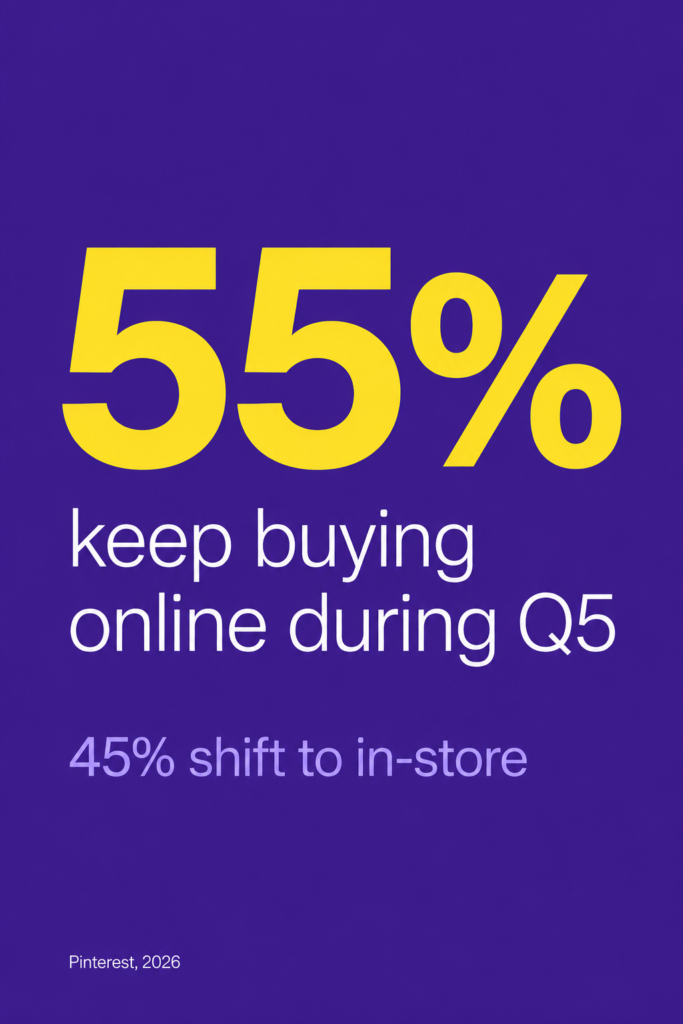
That’s genuinely the whole trick. Most stores pause spend on December 26th because the “holiday” feels over. Pinterest’s own 2026 data says otherwise: 55% of weekly Pinterest users keep buying online during that week, and 45% shift to shopping in-store, which means online demand doesn’t fall off a cliff, it just changes shape.
The move here isn’t “spend more.” It’s “don’t stop, and pivot the creative.” Swap holiday gifting messaging for:
- New Year inspiration pins (resolutions, resets, fresh starts)
- Gift-card redemption prompts, since a lot of December 25th gift cards get spent within days
- “New year, new home” boards if that’s relevant to your category
The nice part about this section, honestly, is that it’s the cheapest one on the whole calendar. You’ve already done the hard work in August through November. Q5 is just refusing to turn the lights off a week early.
January: extend the window, then look back
In one sentence: January is for stretching the “new year” energy a little further with a couple of specific moves, then closing the loop on what Q4 actually taught you.
If you sell into home, wellness, or organization, Pinterest’s own idea and board pages show real, visible interest in “new year new home” and reset-themed content through January. That’s a directional interest signal, board and search activity, not a hard statistic Pinterest has quantified, but it’s genuine and under-used if it fits your category. Concretely:
- Publish a focused run of New Year reset pins and boards, organization, decluttering, “new year new home,” self-care resets, sized to whatever’s relevant for your category, not a token pin or two tacked on after December.
- Let your Q5 gift-card messaging run into the first week or two of January. A meaningful share of December 25th gift cards get redeemed in the days after, not on the day itself, so pulling that messaging on January 1st leaves money on the table.
- Then close the loop: pull your Q4 performance data broken out by month, not just the quarter total. What worked in September’s tests, what you scaled in November, what your Q5 pivot actually did to conversions in that last week of December.
This is what makes next year’s Pinterest Q4 calendar easier to build than this one was.
What we don’t know yet
Being upfront about this matters more than pretending otherwise: Pinterest has not published category-level, week-by-week timing data for 2026. There’s no official breakdown of “gifting searches peak here, decor searches peak there, food searches peak somewhere else.” What exists is the general September-to-November launch window and the two-months-before-peak rule. If you sell across multiple categories, apply that general rule per category based on when each one’s moment actually happens, rather than looking for a precision that Pinterest simply hasn’t published.
FAQ
When should I start my Pinterest holiday campaign in 2026?
Pinterest’s own 2026 guidance recommends going fully live as early as possible within a September-to-November window, after foundational work (catalog, tag, KPIs) is done in August. The underlying rule, straight from Pinterest’s Marketing Moments guide, is to launch roughly two months before the relevant search peak for your category.
What is Pinterest’s “Q5” and should I keep advertising after Christmas?
Q5 is Pinterest’s own term for December 26th through January 1st. Pinterest’s 2026 data shows 55% of weekly users keep buying online during that week, with 45% shifting to in-store. Yes, keep campaigns live, just pivot creative toward New Year themes and gift-card redemption instead of pausing after Christmas.
Do Pinterest ad costs really go up in Q4?
Likely yes, though Pinterest hasn’t published exact figures. Agency estimates suggest CPMs can rise roughly 20-30% above baseline heading into November as more advertisers compete for a shrinking pool of undecided shoppers. Treat specific numbers as directional, but the pattern (cheaper in September, pricier by November) shows up consistently, and it’s worth building into your Pinterest Q4 calendar regardless of the exact figures.
What’s the first thing I should fix on my Shopify store before Q4 Pinterest campaigns?
Your product feed. Check stock accuracy, pricing sync, and broken URLs before spending a cent on ads. Pinterest’s own guidance lists this as step one of its four-step framework, and feed issues can get products flagged or, in worse cases, your catalog temporarily suspended during exactly the weeks you need it working.
Is it too late to start if I’m reading this in September, October or November?
No. In September you’re barely behind at all: run August’s foundation checklist this week and you’re back on the calendar with the cheap testing window still open. From October or November you can still launch, since Pinterest’s official window runs through November. You’ll skip the cheaper September CPMs and the extended testing runway, but foundational work (feed, tag, KPIs) still needs doing first regardless of the month, and Q5 in December is still fully ahead of you. The rest of this Pinterest Q4 calendar still applies to you from wherever you’re starting.
What should I post on Pinterest in January after the holidays end?
“New year, new home” content, resets, organization, and wellness themes show real interest on Pinterest’s own idea and board pages in January, particularly for home, wellness, and organization categories. It’s not a hard Pinterest statistic, more a directional signal, but it’s a genuinely under-used window worth a few pins if it fits your store.
Feeling behind is the default state of running a Shopify store in Q3. It doesn’t mean you actually are.