The question you’re still asking is outdated
Here’s the short version: Pinterest for Shopify stores works differently in 2026 than it did in 2022, because commerce now drives roughly two-thirds of Pinterest’s revenue. If your strategy hasn’t moved since you set up the board, you’re managing a platform that no longer exists in that form.
You know the story, because it’s probably yours. You set up a Pinterest business account a few years ago, pinned a handful of product shots one weekend, and never went back. The board is still there. Nobody’s touched it. And honestly? That’s a completely reasonable thing to have happened – you had a store to run, and Pinterest looked like a nice-to-have next to whatever was actually converting.
The mental model behind that neglect – Pinterest as a moodboard, a pleasant trickle of traffic, something between Instagram and a scrapbook – was accurate enough in 2021. It isn’t anymore. So the question “what are some ways to use Pinterest for ecommerce” is the wrong question for 2026, because it assumes you’re picking from a menu of equally-weighted tactics.
You’re not. Pinterest for Shopify stores in 2026 is about sequencing, not selection. Some moves matter this week. Others genuinely don’t matter yet if you’re based in the EU. Get the order wrong and you burn the one thing founders never have spare: time.
What actually changed: Pinterest’s Q1 2026 numbers
Pinterest’s Q1 2026 results confirm the platform has become a genuine sales channel, and Europe is growing faster than the US while it happens.
The numbers back this up. Global revenue reached $1.008 billion, up 18% year-over-year, on 631 million monthly active users (up 11%). Europe is the standout: 159 million MAU (+7% YoY) and $186 million in revenue (+27% YoY, +16% at constant currency). Around 30% of lower-funnel revenue now flows through Performance+, Pinterest’s AI-driven ad system, which is a meaningfully larger share than a year ago (source: ALM Corp, Pinterest Q1 2026 results, May 2026).
If you’re an EU Shopify founder, don’t file this under “interesting stat.” File it under “already behind schedule.” Europe’s Pinterest revenue is growing faster than America’s, which means Pinterest’s own roadmap increasingly has to work for European merchants, not just US ones. You’re not waiting on a feature to eventually cross the Atlantic. The growth is already sitting in your own backyard.
Which means: if you set a Pinterest strategy once, years ago, and haven’t revisited it since, you’re quietly ignoring a channel that’s growing at close to double digits in your own market. Nobody did that on purpose. It just happens when a platform gets deprioritized and stays that way.
Pinterest for Shopify stores: what to do first, second, third, and what to skip
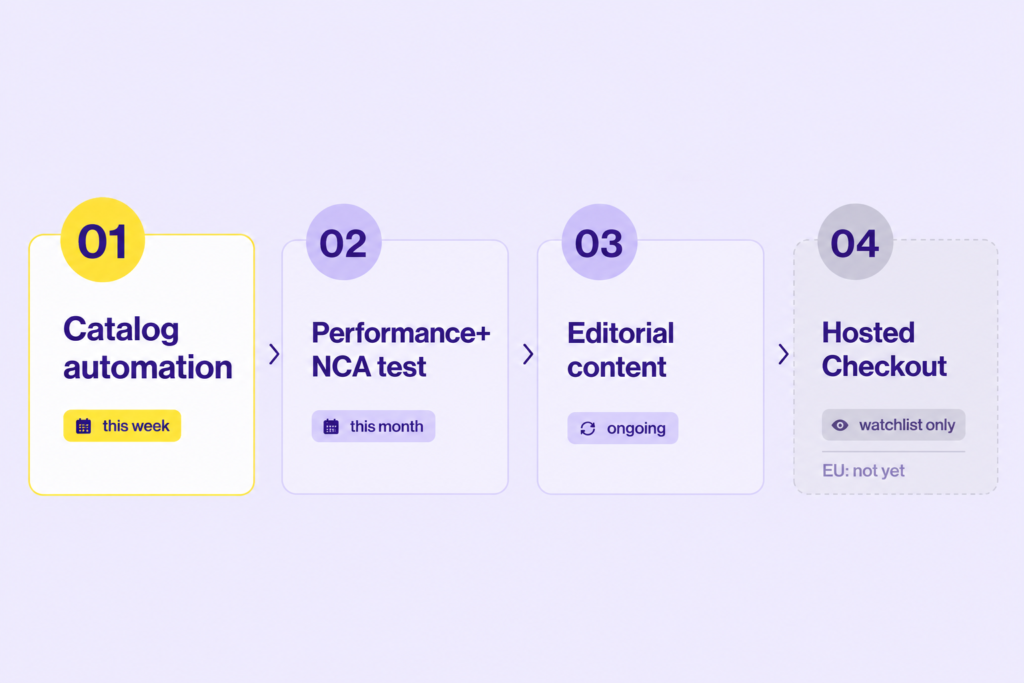
There are four things worth your attention right now, and they have a clear order. Do them out of order and you’ll spend effort on the wrong problem.
Most guides on Pinterest for Shopify stores hand you a flat list – “7 Pinterest tips,” “10 ways to sell more” – as if every item deserves equal time. It doesn’t. Here’s what actually moves the needle, ranked.
Priority 1: Automate your full catalog (do this first, this week)
If you’re still uploading pins one product at a time, this is where you start, full stop.
Catalog-driven ads are cutting cost-per-acquisition by 35% compared to static shopping ads, and manual pin-uploading is consistently flagged as the most common mistake among Shopify merchants on Pinterest (source: Releasebot industry roundup, 2026). As one guide puts it bluntly: gone are the days of uploading your entire offering and forgetting about it.
Practically, that means connecting Shopify’s native Pinterest app, verifying your full product feed is actually syncing (not just the ten items you added by hand back in 2023), and double-checking your product tagging is clean. This takes an afternoon, not a quarter. If you’d rather hand it off, catalog setup is part of what I do for EU Shopify brands.
Priority 2: Test Performance+ Customer Acquisition (NCA)
Once your catalog is live, test this next, because it’s now a one-click launch from inside your existing Shopify integration.
Pinterest rolled this out in June 2026: you upload customer data, and Pinterest’s AI prioritizes targeting toward people who look like new buyers rather than repeat browsers. Early testing showed a 64% average lift in new-customer conversions (source: MediaPost, June 2026).
This matters most if you’re in a high-LTV category – beauty, home decor, anything where the value of a new customer compounds over time. If your margins are thin and repeat purchase isn’t really your model, it’s still worth a small-budget test, but don’t expect the same lift. I’ll keep unpacking what’s actually working in Pinterest ads as I test it with clients.
Priority 3: Build an editorial content stream for planners, not scrollers
People searching Pinterest are usually planning something – a renovation, an outfit, a gift – so they need fresh, search-titled boards and pins, not a repackaged product feed.
This is the piece most Shopify founders skip, because it feels like “content marketing” rather than “selling.” But 36% of Pinterest users now start their searches on Pinterest instead of Google, and that climbs to 39% among Gen Z (source: Sprout Social 2026, via Lia Haberman). People are using Pinterest the way they’d use a search engine, so title your boards like search terms – “Modern Kitchen Renovation Ideas,” not “My Dream Home” – and feed them seasonal content.
Pinterest Predicts 2026 is a genuinely useful prompt list here: aubergine kitchens, niche perfume layering, afrobohemian decor are all trending searches you can build content around if they fit your niche. I break down Pinterest trends and seasonal planning here as new data lands.
Which pin formats actually earn that search traffic is its own question, and I answered it separately in my breakdown of the formats that work for planners rather than scrollers.
Watchlist: Hosted Checkout (not a 2026 action item for EU brands yet)
Hosted Checkout, which lets shoppers buy without ever leaving the Pinterest app, is live and working well. It’s US-merchant-only right now, though, and it requires Verified Merchant Program approval that EU brands can’t complete yet.
So don’t chase this one this year. What you can do is get Verified Merchant status now, so you’re first in line when it does expand. Verified Merchants already see 17% higher conversion even without Hosted Checkout, so there’s an upside either way (source: ExactWhy, April 2026).
What this looks like in practice: the Pilgrim example
A Danish jewelry brand called Pilgrim did exactly this sequence, and it worked at real EU scale, not just in a case study slide.
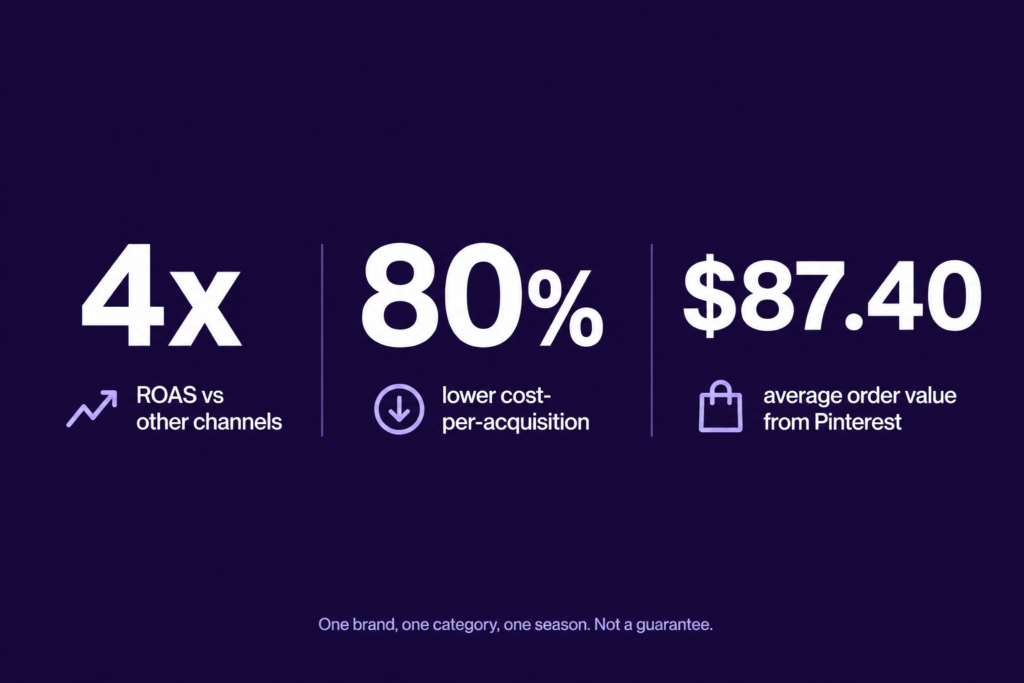
Pilgrim connected its Shopify catalog through Pinterest’s commerce integration and saw 4x the ROAS of its other channels, with 80% lower cost-per-acquisition. Its strongest sales periods landed around Black Friday and Christmas, which tracks with how people actually use Pinterest to plan gifts weeks in advance (source: Shopify blog roundup, 2026).
The broader numbers back up the pattern. Pinterest-referred shoppers show a $87.40 average order value, 28% above the social commerce average, and 80% of Pinterest store traffic is entirely new visitors, not returning ones (source: Shopify x Pinterest Commerce Integration report, January 2026).
One honest caveat: Pilgrim is one brand, not a guarantee for yours. Jewelry has strong visual appeal and clear gifting occasions, which helps. But it does show the mechanism – catalog plus Performance+ – actually working at EU scale, which is more than most case studies floating around right now can claim.
Common mistake: follower count doesn’t decide this
Success with Pinterest for Shopify stores isn’t gated by how many followers you have. A brand-new account with zero followers can still rank, because Pinterest works more like a search engine than a social feed.
This matters specifically if you’re one of the founders who tried Pinterest years ago, watched the follower count sit at 40, and quietly decided it wasn’t worth the effort. That conclusion made sense under the old model. It doesn’t hold anymore, because ranking depends on search relevance and board optimization, not audience size (source: Tailwind, Pinterest myths debunked, 2026).
Pinterest’s own engineers have since published more detail on how that ranking works, and follower count still isn’t part of it. I went through what they actually said in Pinterest just changed how it ranks your pins.
So if that’s the reason you shelved Pinterest, it’s worth reopening the account. The follower count you’re embarrassed about isn’t actually the obstacle you think it is.
Where to start with Pinterest for Shopify stores this week
You don’t need a new strategy. You need to reorder the one you already have.
Three things, in order: connect and verify your full catalog this week, run a small Performance+ NCA test once that’s live, and start one editorial board built around a search term your customers actually use. Everything else on the priority list can wait.
If you’re reading this in the run-up to Q4, the same three priorities hold, just on a tighter clock. I mapped out what that looks like month by month in my Pinterest Q4 calendar for Shopify stores.
That’s it. No new platform to learn, no follower count to fix, no need to wait for a US-only feature to arrive. What’s actually stopping you from opening the Pinterest app this week?
If the honest answer is time rather than know-how, that’s the part I take off founders’ plates.
FAQ
Is Pinterest for Shopify stores still worth it in 2026?
Yes, and more so than a few years ago. Pinterest’s Q1 2026 revenue grew 18% year-over-year, with Europe outgrowing the US at +27%. Around 30% of lower-funnel revenue now flows through AI-driven Performance+ campaigns, confirming the platform has genuinely shifted from inspiration to sales, especially for EU merchants.
What’s the difference between Pinterest ads and Performance+ campaigns?
Standard Pinterest ads are manually targeted and managed. Performance+, including the new Customer Acquisition feature launched June 2026, uses AI to prioritize targeting based on your uploaded customer data and launches in one click from an existing Shopify integration. Early results show a 64% average lift in new-customer conversions.
Do I need a large following to succeed on Pinterest?
No. Pinterest functions more like a search engine than a social feed, so new accounts with zero followers can rank well if boards and pins are titled and tagged with real search terms. Follower count has little bearing on whether your content actually surfaces in search results.
Is Pinterest Hosted Checkout available for EU/Shopify merchants?
Not yet. Hosted Checkout, which lets shoppers complete purchases inside the Pinterest app, is currently US-merchant-only and requires Verified Merchant Program approval. EU brands should apply for Verified status now to be ready when the feature expands, since verification alone already boosts conversion by 17%.
How much does catalog automation cost or how long does it take to set up?
Connecting Shopify’s native Pinterest app and verifying your full product feed typically takes an afternoon, not a major project. There’s no separate cost beyond your existing Shopify and Pinterest accounts. The main work is confirming your feed syncs completely and your product tagging is accurate.
What should EU Shopify founders do first if they haven’t touched Pinterest in years?
Start with catalog automation this week – it’s the highest-leverage fix for Pinterest for Shopify stores, since manual pin-uploading is the most common and costly mistake. From there, test a small Performance+ NCA campaign and build one editorial board around real search terms. Hosted Checkout can wait until it reaches EU merchants.